
Homeowner Guide
Elevator for 2 Story House: Space, Permits and Real Costs
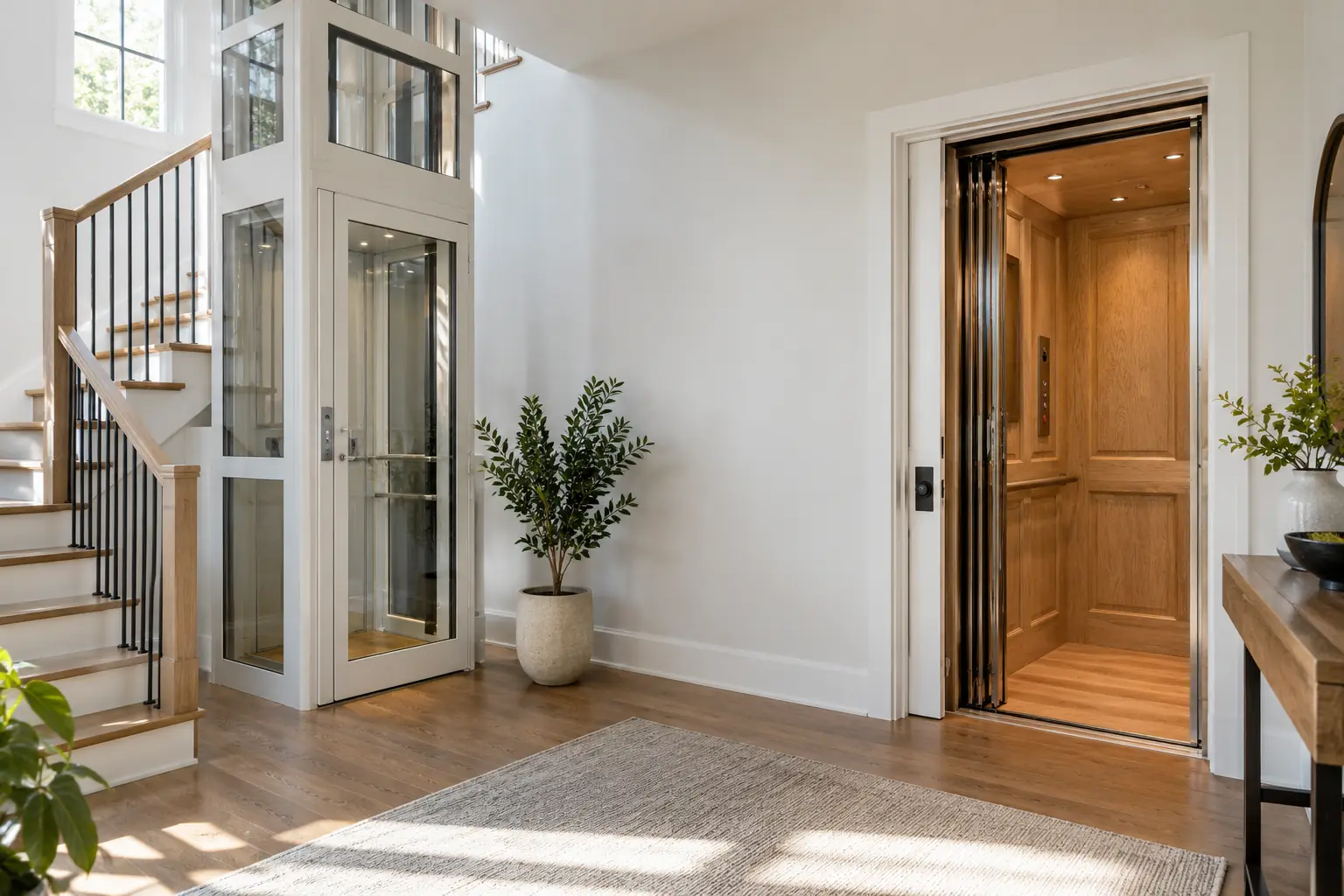
Yes. Most two-story houses can fit an elevator. A shaftless through-floor lift needs about 7 square feet and no shaft. A pneumatic tube needs a 30 to 53 inch circle. A traditional elevator needs a framed shaft, an 8-inch or deeper pit and about 92 inches of headroom. Expect roughly $30,000 to $60,000 installed for two stops.
Yes, you can put an elevator in a two-story house, and most homes have at least one spot that works. An elevator for a 2 story house can be as small as a 7-square-foot shaftless lift that plugs into a wall outlet, or as large as a full shaft elevator with room for a wheelchair and a second rider. Installed prices for two stops usually run $30,000 to $60,000.
This guide covers the space each type needs, the structural and permit steps, and the real cost bands, so you can tell which option fits your floor plan before you call anyone.
Can you put an elevator in a two-story house?
In most cases, yes. A two-story home is the easiest kind of house to add an elevator to, because the lift only has to travel one floor. That keeps the rise short, the shaft small and the price at the lower end of every range.
The real question is where it goes. Every elevator needs three things:
- A stacked footprint. A spot on the first floor with open space directly above it on the second floor.
- A floor opening. A hole cut through the second-floor structure, framed so the floor stays strong.
- Power. Either a standard outlet or a dedicated circuit, depending on the model.
Common spots include stacked closets, a corner of the stairwell, a corner of the garage below a bedroom, or a new shaft built on an outside wall. Our guide to adding an elevator to an existing house walks through each placement in more detail.
How much space does an elevator for a 2 story house need?
Space depends almost entirely on the type of elevator. The figures below come from manufacturer planning documents. Treat them as starting points, since final sizes come from the installer's drawings.
| Type | Footprint | Pit | Power |
|---|---|---|---|
| Shaftless, two-person (Stiltz Duo Alta) | Car about 34 x 29 in; floor cut-out 41 x 32 in | None | Standard outlet |
| Pneumatic, one person (PVE30) | 30 in diameter tube | None | Ask installer |
| Pneumatic, wheelchair size (PVE52) | About 53 in diameter tube | None | Ask installer |
| Traditional hoistway (Savaria Infinity) | Cab 36 x 48 in to 40 x 54 in, plus shaft walls | 8 in minimum | 230V, 30 amp dedicated circuit |
Sources: the Stiltz Duo Alta technical specification, PVE model listings, and the Savaria Infinity planning guide.
Height matters too. A traditional elevator needs headroom above the top landing. Savaria lists a minimum overhead clearance of 92 inches for a standard 80-inch cab. Standard 8-foot ceilings can work, but taller cabs need more room.
Which type of elevator is best for a two-story home?
There is no single best type. Each one trades space, price and capacity differently. Here is how they compare for a one-floor trip.
Shaftless (through-floor) elevators
A shaftless elevator rides on rails and passes through a hole in the ceiling. No shaft, pit or machine room is needed. These are the smallest and usually cheapest true elevators, and many serve two floors only.
The Stiltz Duo Alta, for example, carries up to 375 pounds and travels a maximum of about 14 feet 9 inches. Read how a shaftless elevator works for the limits.
Pneumatic (vacuum) elevators
A pneumatic elevator moves a car inside a clear tube using air pressure. It needs no pit and no hoistway. Sizes run from a 30-inch one-person tube to a 52-inch tube that fits a wheelchair. They cost more than most shaftless models.
Traditional hoistway elevators
Hydraulic, cable drum and traction elevators run inside a framed shaft. They give the biggest cabs, the highest weight limits and the most finish options. They also need the most construction. See our comparison of home elevator types for how each drive system works.
How much does a 2 story home elevator cost?
For two stops, HomeGuide puts a typical installed elevator at $30,000 to $60,000, with a national average near $48,000. Other guides show lower floors for shaftless models. The ranges differ because some quote the unit alone and others quote a finished install.
| Option (two stops) | Typical installed range | Source |
|---|---|---|
| Shaftless elevator | $15,000 to $25,000 | Bob Vila |
| Shaftless or through-floor lift | $30,000 to $40,000 | Savaria |
| Hydraulic elevator | $25,000 to $50,000 | Bob Vila |
| Pneumatic elevator | $35,000 to $60,000 | Bob Vila |
| Traditional hoistway elevator, 2 to 3 stops | $45,000 to $75,000 | Savaria |
Extra project costs often sit outside the elevator price. HomeGuide lists permits at $300 to $2,000, a dedicated electrical circuit at $250 to $900, a panel upgrade at $1,300 to $4,000 if your panel is full, and inspections at $150 to $700. For the full line-item view, see our 2026 home elevator cost guide.
Do you need a permit to add an elevator to a house?
Almost always. Cutting a floor opening is structural work, and new wiring needs an electrical permit. Many states also have an elevator safety office that reviews residential installs. Rules vary by state and city, so ask your installer which permits they pull and whether a state inspection follows.
Ask about door safety, too. The Consumer Product Safety Commission warns that the gap between the hallway door and the car door should be no more than 4 inches, to prevent a child from being trapped. The current ASME A17.1 code (the national elevator safety standard) sets that limit. Any new install should meet it.
What structural work does a two-story elevator need?
This is the part most cost pages skip, and it is often where quotes differ. Before an installer can price the job, someone has to confirm what is in the way.
- Floor framing. The opening usually cuts through floor joists. A contractor frames a header around the hole to carry the load.
- Hidden services. Ducts, pipes and wiring in the ceiling may need rerouting.
- Floor strength below. Shaftless lifts sit on the existing floor. A traditional elevator needs a pit floor built to carry its load; Savaria suggests an 8-inch concrete slab.
- Electrical capacity. A traditional elevator needs its own circuit and a lighting circuit. An older panel may not have room.
- Finishes. Drywall, trim and flooring around the opening need patching and paint.
Ask each installer whether these items are in the quote or left to your own contractor. That single question explains most of the gap between a $25,000 quote and a $45,000 one.
Does an elevator add value to a two-story house?
Do not count on it. HomeGuide cites a National Association of Home Builders finding that 56% of buyers are unlikely to buy a home with an elevator. Some buyers will value one, but plan the elevator for your own use rather than resale.
There is a possible tax angle. IRS Publication 502 says an elevator installed for medical care can count as a medical expense, but only for the cost above any increase in home value. In the IRS example, an $8,000 elevator that adds $4,400 in value leaves $3,600 as a medical expense. Check with a tax professional before you rely on this.
What to do next
Start by measuring two candidate spots: one closet-sized corner and one larger area such as a stairwell or garage corner. Check what sits directly above each one. Then get at least two written quotes that list the structural, electrical and permit work as separate lines. You can get a local price from a vetted installer in your area using the form on this page.
Frequently asked questions
What is the smallest elevator for a 2 story house?
Shaftless two-person lifts are among the smallest. The Stiltz Duo Alta has an outside car size of about 34 by 29 inches and needs a floor cut-out of about 41 by 32 inches, according to its technical sheet. The one-person PVE30 pneumatic elevator is a 30-inch tube. Both skip the pit and shaft, which keeps construction light.
Can you put an elevator in a house without a shaft?
Yes. Shaftless and pneumatic elevators do not need a built hoistway. A shaftless lift rides on rails through a ceiling opening, and a pneumatic lift runs inside its own clear tube. You still need a floor opening, framing around it and suitable power. Traditional hydraulic and traction elevators do need a framed shaft and a pit.
How long does it take to install an elevator in a two-story house?
The lift itself can go in quickly. Stiltz says a standard install of its home lift can take just one day once a contractor has cut and framed the ceiling opening. Traditional shaft elevators take longer because framing, a pit, wiring and inspections come first. Ask each installer for a written timeline.
Is a stair lift cheaper than an elevator for a two-story house?
Usually, yes. HomeGuide puts a stair lift at $2,000 to $15,000 installed, compared with roughly $30,000 to $60,000 for a two-stop elevator. A stair lift needs a rider who can transfer to a seat and leaves the stairs in use. An elevator carries people, a wheelchair on larger models, and items like laundry or groceries.
Does a home elevator need yearly inspections?
It depends on your state. HomeGuide notes that most states require yearly inspections at $150 to $700 each, while some states exempt elevators in private homes. Your installer should know the local rule. Even where inspection is not required, a yearly service visit keeps the warranty valid and checks safety parts like the door locks.

Get prices from a vetted local installer
Tell us about your home. We connect you with one licensed home elevator or stair lift installer in your area. No spam, no call centers.
Sources
- HomeGuide: Home Elevator Cost (2026)
- Savaria: How Much Is a Home Elevator?
- Bob Vila: Home Elevator Cost
- Stiltz Duo Alta Technical Specification
- Savaria Infinity and Infinity HD Planning Guide
- Lifeway Mobility: PVE Vacuum Elevator models
- CPSC: Deadly Gap Between Doors of Home Elevators
- IRS Publication 502: Medical and Dental Expenses