
Homeowner Guide
Types of Home Elevators: 6 Drive Systems Compared (2026)
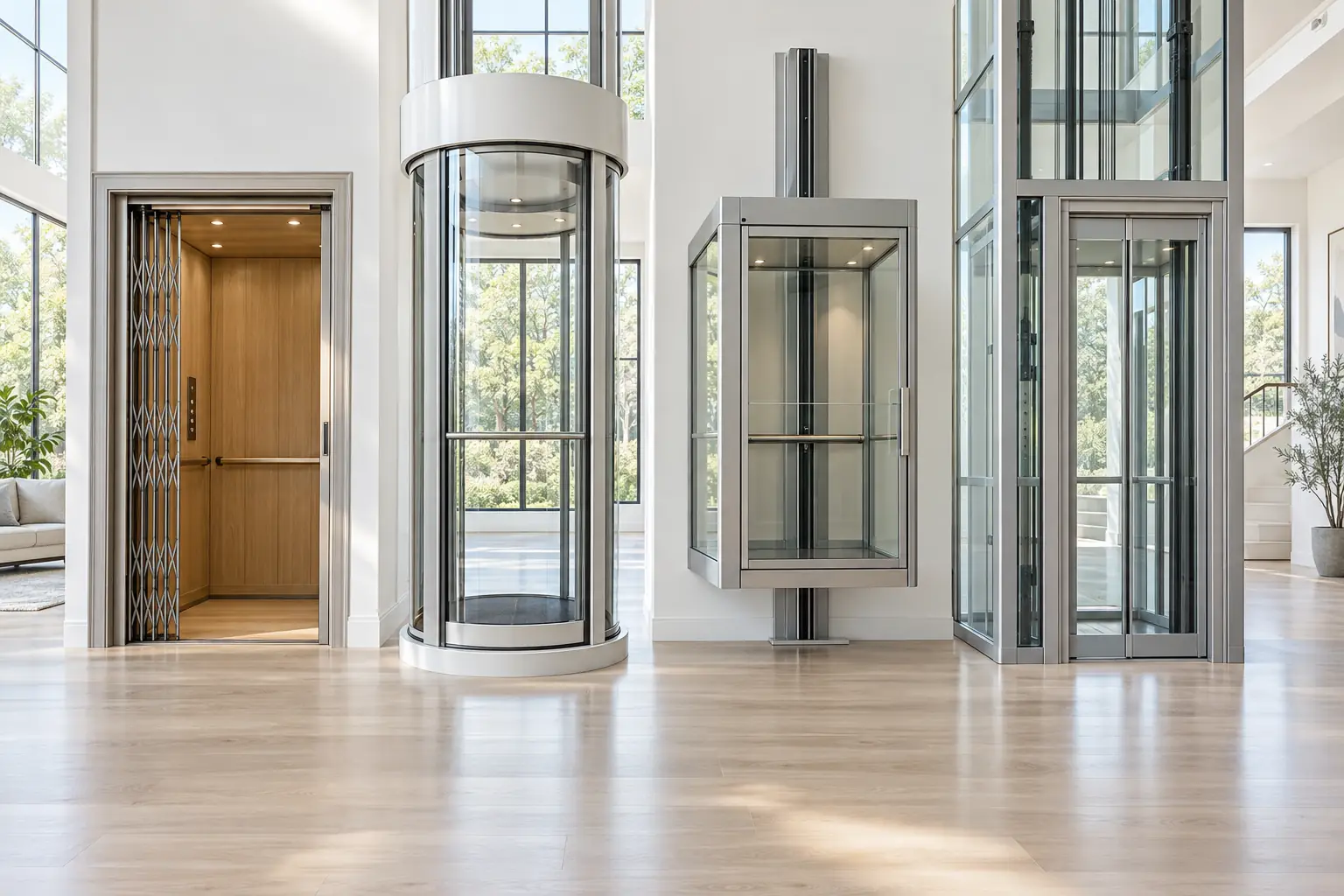
There are six main types of home elevator, named after how they move: hydraulic, winding drum (cable), geared chain or counterweight traction, gearless traction, pneumatic vacuum and shaftless through-floor. Installed two-stop prices run from about $28,000 for a winding drum to $50,000 to $75,000 for gearless traction. The right type depends mostly on the space you have and how much building work you can accept.
Home elevators come in six main types, and the type is named after the drive system, the machinery that moves the car. Hydraulic, winding drum, chain or geared traction, gearless traction, pneumatic vacuum and shaftless through-floor lifts all carry people between floors, but they differ in how much space they need, whether you must build a shaft and pit, how quiet they are, and what they cost. HomeGuide's 2026 cost data puts most two-stop installs between $28,000 and $75,000, with pneumatic models reaching $100,000.
If you are new to the subject, start with our plain guide to what a home elevator is. This page goes one level deeper: how each drive works, what it asks of your house, and which questions settle the choice.
The six home elevator types at a glance
| Type | How it moves | Shaft / pit | Machine space | Installed cost (2 stops) |
|---|---|---|---|---|
| Hydraulic | Pump pushes oil into a cylinder | Shaft, usually a shallow pit | Separate machine room | $30,000 to $60,000 |
| Winding drum | Motor winds cable on a drum | Shaft | Separate space or above the rail | $28,000 to $50,000 |
| Geared chain / counterweight | Motor and chain, offset by counterweights | Shaft, extra overhead | Inside the hoistway | $30,000 to $60,000 |
| Gearless traction | Gearless motor with counterweight | Shaft, extra overhead | Inside the hoistway | $50,000 to $75,000 |
| Pneumatic vacuum | Air pressure in a sealed tube | No shaft, no pit | None (unit on top of tube) | $35,000 to $100,000 |
| Shaftless through-floor | Car rides wall or self-standing rails through a floor opening | No shaft, no pit | None | $30,000 to $50,000 |
Cost ranges are HomeGuide's installed averages for a two-story home. Your price moves with cab size, finishes, doors and, above all, the building work your home needs. Our 2026 cost guide covers those factors in detail.
1. Hydraulic home elevators
A pump pushes hydraulic oil into a cylinder, which raises the car. To go down, oil is let out of the cylinder. Lifeway Mobility, an installer that sells all four shafted drive types, says hydraulic drives are generally capped at about 40 feet per minute and need a separate machine room for the pump.
- Good at: smooth, quiet rides and heavy loads. The machine room can sit some distance from the shaft, which helps in awkward layouts.
- Watch for: you need space for that machine room, and the system uses hydraulic fluid.
- Typical fit: larger homes, new builds and cabs sized for a wheelchair.
2. Winding drum (cable) elevators
The winding drum is the original elevator drive. A motor turns a drum that winds or unwinds steel cable attached to the car. Lifeway lists speeds of 30 to 40 feet per minute and calls it the least costly drive with low maintenance. The machinery sits in a separate space or above the rail if there is enough overhead room, and the drum gets bigger as travel height increases.
- Good at: keeping the price down. HomeGuide's range for a two-stop winding drum install starts at $28,000, the lowest of the shafted types.
- Watch for: where the equipment goes. You still need a full shaft.
3. Geared chain and counterweight traction
A motor at the top of the hoistway pulls the car, and a stack of counterweights between the rails balances the car's weight so the motor works less. Some models use a roller chain instead of cable. Savaria, one of the largest residential elevator makers, calls its chain-driven Eclipse its best-selling home elevator and describes the counterweight as removing the need for hydraulic fluid in the home. Its geared traction Zenith model is rated at 1,400 pounds.
- Good at: energy use, and keeping all equipment inside the hoistway, so you do not give up a closet for a machine room.
- Watch for: more overhead space at the top of the shaft and an access hatch for service.
4. Gearless traction elevators
Gearless traction uses the same counterweight idea with a gearless motor and roller guides like those in commercial passenger elevators. Lifeway calls it the newest drive in home elevators: quieter, faster and the most energy efficient, drawing about 6 amps going up. The catch is price. Lifeway estimates gearless at roughly 1.5 times the cost of other drives, and HomeGuide's installed range is $50,000 to $75,000.
- Good at: ride quality and low noise, which matters when the elevator sits next to a bedroom.
- Watch for: cost and the same overhead and hatch needs as geared traction.
5. Pneumatic vacuum elevators
A pneumatic vacuum elevator is a clear round tube with a car inside. A unit on top of the tube changes the air pressure above the car to lift it, and lets air back in to lower it. There is no shaft to build, no pit to dig and no machine room. Pneumatic Vacuum Elevators (PVE), the best-known maker, sells three round sizes:
| Model | Capacity | Outside diameter | Suits |
|---|---|---|---|
| PVE30 | 1 person, about 350 lb | About 30 in (750 mm) | Tight spaces, one rider |
| PVE37 | 2 people, about 450 lb | About 37 in (933 mm) | Couples |
| PVE52 | 3 people or a wheelchair, about 525 lb | About 52 in (1,316 mm) | Wheelchair access |
Specifications are from PVE dealer listings; check the current spec sheet before you plan the space. Pneumatic units are slower than shafted elevators, at about 0.15 meters per second (roughly 30 feet per minute), and buyers often mention the sound of the air system. Their small, round footprint is the main reason people choose them for existing homes.
6. Shaftless through-floor elevators
A shaftless lift is a compact car that travels through an opening cut in the ceiling. When the car is downstairs, a panel on its roof closes the opening. HomeGuide notes these need no hoistway, pit or machine room, which makes them the easiest type to retrofit, but they carry less weight and can pass through only one floor. Stiltz, the brand that runs the most home elevator ads in the US, says its self-standing models plug into a dedicated 220V, 15A outlet and can often be installed in about a day.
Shaftless lifts are also where search demand is moving. Google Trends shows "shaftless home elevator cost" up about 200% and "small home elevator cost" up about 150% in recent periods, among the fastest-rising elevator searches in the US.
Which type of home elevator suits your house?
Most ranking guides stop at listing the types. In practice, four questions narrow the choice fast:
- How many floors? Shaftless through-floor lifts serve two levels. For three or more, you are choosing between hydraulic, traction and some pneumatic models.
- Is there a stacked space? A closet directly above another closet is the classic home for a shafted elevator. Without one, a pneumatic tube or a shaftless lift in the corner of a room avoids building a shaft.
- Does it need to take a wheelchair? Cab size drives this. HomeGuide notes a door under 32 inches wide is too narrow for most standard wheelchairs. Among pneumatic models, only the largest size takes one.
- Where can the machinery go? Hydraulic needs a machine room. Traction needs extra overhead. Pneumatic and shaftless need neither.
| Your situation | Types to shortlist |
|---|---|
| Two-story existing home, little room for construction | Shaftless through-floor, pneumatic |
| New build or major remodel, three or more floors | Hydraulic, geared or gearless traction |
| Wheelchair access needed | Hydraulic or traction with a large cab, PVE52-size pneumatic, wheelchair-size shaftless models |
| Raised coastal home, garage to main floor | Hydraulic or traction, often in an exterior shaft |
| Lowest shafted cost | Winding drum |
| Quietest ride next to bedrooms | Gearless traction |
Safety rules apply to every type
In the US, residential elevators are covered by the private-residence section of ASME A17.1, adopted and enforced state by state. Most states require a licensed installer, a permit and inspections, and HomeGuide notes that most states mandate an annual inspection. Whatever type you choose, ask the installer to confirm that the gap between the car door and the hoistway door meets the 2016 code limit of four inches. That rule was tightened after child entrapment incidents in older elevators.
Questions to ask before you choose a drive
- Which drive do you recommend for my home, and why not the others?
- What pit depth, overhead clearance and machine space does this model need?
- What power supply does it need, and will my electrical panel need an upgrade?
- How does the elevator behave in a power cut, and is battery backup included?
- How loud is it in operation, and can I ride one you have installed?
- What does yearly maintenance involve and cost?
Next step
Once you have a shortlist of one or two types, the most useful next move is an in-home measure. An installer can check your floor plan, power and structure in under an hour and tell you which types physically fit. If you want a starting point, get a local price from a vetted installer in your area.
Frequently asked questions
What is the cheapest type of home elevator?
Among shafted elevators, the winding drum drive is usually the least expensive, with HomeGuide's installed range starting at about $28,000 for two stops. Shaftless through-floor lifts can cost less overall because they avoid building a shaft, with installed prices from about $30,000. Building work in your home often moves the total more than the drive type does.
Which home elevator type is the quietest?
Gearless traction is generally the quietest, according to installers that sell every drive type, because it uses a gearless motor and roller guides. Hydraulic drives are also known for a smooth, quiet ride. Pneumatic vacuum elevators are often described as louder because of the air system, so ride a working unit before you buy.
Do all home elevators need a shaft?
No. Pneumatic vacuum elevators travel inside their own clear tube, and shaftless through-floor lifts pass through an opening cut in the ceiling, so neither needs a built shaft, pit or machine room. Hydraulic, winding drum and traction elevators all need a hoistway, usually with a shallow pit.
Which home elevator type works for a wheelchair?
Hydraulic and traction elevators with a large cab are the usual choice. HomeGuide notes a door narrower than 32 inches is too tight for most standard wheelchairs. Among pneumatic models, the largest size (PVE52) takes a wheelchair, and some shaftless brands make a wheelchair-size model. Confirm the cab and door size in writing.
How fast does a home elevator travel?
Home elevators are slow compared with commercial ones. Hydraulic and winding drum drives typically run at 30 to 40 feet per minute, and pneumatic vacuum elevators at about 0.15 meters per second, or roughly 30 feet per minute. For a typical one-floor trip, that means a ride of well under a minute.

Get prices from a vetted local installer
Tell us about your home. We connect you with one licensed home elevator or stair lift installer in your area. No spam, no call centers.